If you need to approve everything your team does, you don't have a team. You have hostages.
I've seen it dozens of times. A well-meaning engineering leader creates an approval process for "quality." Then another. Then another. Before long, nothing moves without a signature, a thumbs-up in Slack, or a 30-minute "alignment meeting." The team sits idle. The leader drowns. And everyone pretends this is normal.
It's not normal. It's a trust deficit wearing a process costume.
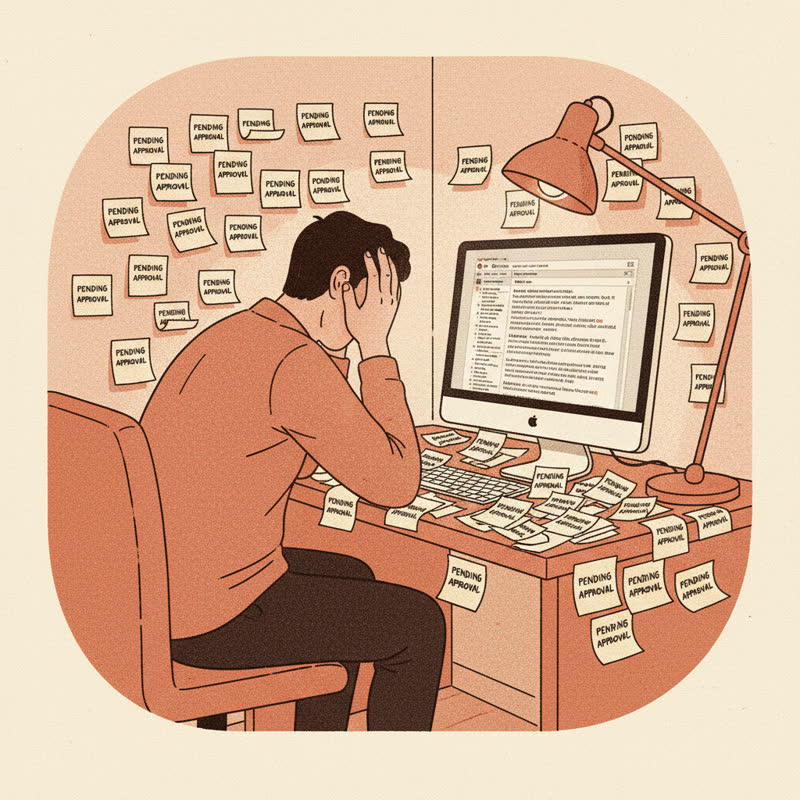
The Approval Queue From Hell
Here's a question worth asking yourself: how many decisions does your team make in a day without asking you first?
If the answer is "not many," you've built an approval bottleneck. Every feature, every deployment, every tiny design choice funnels through one brain. Yours. And your brain, no matter how good it is, has a fixed throughput.
The result? Your team waits. They check Slack for your green light. They context-switch while you're in your third meeting of the morning. They lose momentum, energy, and eventually... interest.
A 2024 study on micromanagement put it plainly: "A manager who needs to approve every detail causes a bottleneck, and makes tasks and projects take much longer than necessary." Micromanaged teams become risk-averse and dependent. They stop proposing ideas because they know ideas need approval, and approval takes forever, so why bother?
The Numbers Are Getting Worse
Gallup's 2025 State of the Global Workplace report dropped some numbers worth sitting with:
- Global employee engagement fell to 21% in 2024. The lowest since the pandemic.
- Only 28% of employees strongly agree their opinions count at work.
- 51% are actively looking for or monitoring new job openings.
- The cost? $438 billion in lost productivity globally.
And here's the number I keep coming back to: 70% of the variance in team engagement comes directly from the manager. Not the company. Not the perks. Not the mission statement on the wall. The manager.
When managers received coaching training, their own engagement rose by 22% and their teams' engagement by 18%. But when managers disengage... well, manager engagement dropped from 30% to 27% globally. For managers under 35, it fell 5 points. For female managers, 7 points.
The people responsible for 70% of engagement are themselves disengaged. No wonder teams feel held hostage.

Garry Ridge Figured This Out at WD-40
Garry Ridge led WD-40 as CEO for over 20 years. During his tenure, the company grew into a multi-billion dollar global brand. His engagement scores crushed industry averages. And his philosophy was refreshingly simple.
"People don't want to have to quack up the hierarchy every time they need to make a decision," Ridge told Forbes. His solution? Clear values, arranged in a hierarchy, with "doing the right thing" at the top.
Values replaced approvals. When your team knows what "the right thing" looks like, they don't need to ask permission. They act. They decide. They own the outcome.
Ridge didn't treat mistakes as failures. He called them "learning moments". No blame. No punishment theatre. The message was clear: if you made a decision in good faith and it didn't work out, we'll learn from it together. The result was confident, autonomous teams who solved problems instead of escalating them.
His book title says it all: Any Dumb Ass Can Do It. Leadership isn't genius. It's getting out of the way.
I wrote about the connection between trust and business results a few weeks ago. Ridge is living proof. Trust isn't fuzzy. It's operational. It scales. And it frees up the bottleneck... which is you.
The Bottleneck Is a Trust Deficit
Let's be honest about why leaders hold onto approvals. It's not about quality. It's about control. And control is often about fear.
Fear of looking bad if a report makes a wrong call. Fear of being blindsided by a decision you didn't sign off on. Fear of being irrelevant if your team doesn't need you for every choice.
Paula Davis, writing for Wharton, identifies lack of autonomy as one of six core drivers of chronic stress and disengagement. She breaks autonomy into six dimensions: schedule, task, decision-making, creative, career, and social. Most approval-obsessed leaders are throttling at least three of those.
The fix isn't complicated. Davis recommends a simple decision framework. Three categories:
- Decisions your team owns outright. No check-in needed.
- Decisions they make and notify you about. You hear about it, but after the fact.
- Decisions requiring discussion first. Reserved for big, irreversible calls.
Most of the decisions your team asks you about right now? They belong in category one. You're holding onto them out of habit, not necessity.
What Letting Go Looks Like
I've been in engineering leadership for a long time. I've been on both sides of this. I've been the bottleneck. I've been stuck behind one. Neither is a good place.
Here's what works when you stop approving and start trusting:
Set the guardrails, not the route. Define what good looks like. Spell out the non-negotiables (security, data privacy, user impact). Then let your team figure out the how. If you've hired engineers, trust them to engineer.
Make "learning moments" the norm. Borrow from Ridge. When something goes wrong, skip the blame. Ask: what did we learn? What would we do differently? This builds a culture where people take smart risks instead of playing it safe to avoid your disapproval.
Kill the unnecessary approval steps. Audit your processes. Every PR review, every deployment gate, every design sign-off. Ask: does this exist because it adds value, or because someone once made a mistake and we built a process around it? If it's the latter, rip it out.
Check yourself. When you feel the urge to weigh in on something, pause. Ask: would this decision matter in a week? If not, let it go. Your job is to be useful on the decisions worth discussing, not present for every choice.
My research found 99.5% of survey respondents said they've had one or more types of bad bosses. The approval-obsessed leader is a variant of the bad boss. Not the most dramatic one. Not the screamer or the credit-stealer. But the quiet kind. The one who kills your momentum with a thousand small delays.

Your Team Is Waiting
Right now, someone on your team has an idea they haven't shared. Not because it's bad. Because the effort of getting it approved exceeds the energy they have left after their third status update of the week.
Someone else finished a task two hours ago but is waiting for your thumbs-up before moving on.
A third person is updating their CV. Not because they hate the work. Because they hate feeling like they need permission to do it.
Garry Ridge built a multi-billion dollar brand by letting people make decisions. Gallup's data shows engagement craters when managers hold too tight. And your own experience, if you're honest about it, tells you the same thing.
Stop being the bottleneck. Define the values. Set the guardrails. Then get out of the way.
Your team doesn't need a gatekeeper. They need a leader who trusts them enough to let them lead.