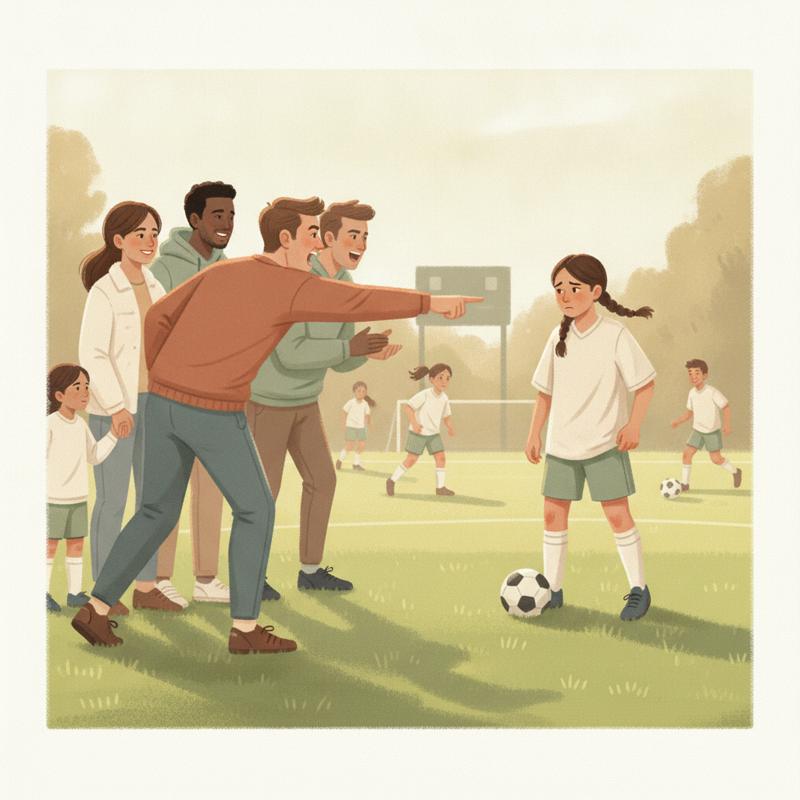
Picture a Saturday morning youth football match.
A dad stands on the touchline, leaning half onto the pitch. "Pass it! No, LEFT! Get back! Shoot!" He shouts for ninety minutes. His voice goes hoarse. He drives home convinced he coached his kid.
He didn't. He instructed. Loudly.
I keep thinking about this scene because Gillian Jones-Williams named it on our podcast, and once she named it I started seeing it everywhere. At work, mostly. In my own habits, too.
Where the confusion comes from
Gillian runs Emerge, a learning and development firm she founded nearly 30 years ago. She co-wrote 50 Top Tools for Coaching, now in its sixth edition. When Debra and I talked with her on Corey-osity Unleashed, she said something I wrote down straight away.
People get confused between coaching and instructing, she said, and the confusion comes from sport. You watch a match, you see the person on the sideline going "no, move over there, get over there, do this," and you think, so this is coaching.
It isn't. Not the kind she means.
The word "coach" carries a picture for most of us. A tracksuit, a whistle, a clipboard, a red face. Somebody who knows the right answer and yells it at people until they do it.
So when a company tells a new manager "you need to coach your team," the manager reaches for the only picture they own. They stand on the touchline and shout.
The kids on the pitch already told us how this feels
Researchers Jens Omli and Diane Wiese-Bjornstal asked 57 children, aged 7 to 14, how they wanted parents to behave at youth sport events. The study, "Kids Speak," published in Research Quarterly for Exercise and Sport in 2011, sorted parents into three roles: the supportive parent, the demanding coach, and the crazed fan.
The kids did not want the demanding coach. A 7-year-old boy said parents "yell and they tell you what to do and they get mad if you don't do it."
An 8-year-old boy described his mum calling every pass for him. Then he said this:
"Let us play the game! We don't want you treating us like remote control cars and telling us exactly what to do!"
Remote control cars. An eight-year-old summed up micromanagement better than most management books I own.
The detail I found most useful was this one. The children did not object to advice. They accepted advice given privately, during breaks, when nobody was watching. A 9-year-old girl said if there is anything to fix, parents should "tell you nicely, not like when you are on the field."
Read those two findings together. Shouting during play hurts. A quiet word during the break helps. Same parent, same knowledge, opposite effect.
Your team works the same way. Calling out every move during a live incident, a demo, or a code review in front of their peers feels like help to you. To them it feels like a joystick.
The real coaching came from sport too
Here's the twist I enjoyed most when I dug into it.
Business coaching did come from sport. The touchline shouter is the part we copied by mistake.
In 1974 a tennis coach called Timothy Gallwey wrote The Inner Game of Tennis. His method relied on players making accurate, non-judgemental observations of what was happening, then letting the body correct itself. Less telling. More noticing.
A British racing driver called Sir John Whitmore trained with Gallwey, brought the Inner Game to Britain in 1979, and started coaching tennis players and golfers. He soon saw the value for leaders and managers. He went on to co-create the GROW model, the framework most managers meet first.
Whitmore's definition of coaching, quoted by Imperial College London, is the one I keep on my wall:
"Coaching is unlocking people's potential to maximise their own performance. It is helping them to learn rather than teaching them."
Helping them learn rather than teaching them. The opposite of the touchline.
So the sport we borrowed from had two kinds of coach in it. A quiet one at the net, watching closely. And a loud one on the sideline, pointing. Most managers copied the loud one.

I was the touchline shouter
I'll own this one.
My background is engineering. For years I resisted becoming a manager. I wanted to write code. People felt squishy and hard to understand. Then I became the last man standing at a company, had to hire people and lead a team, and I hated it at first.
I assumed my coding skill made me the best person to lead the team. I knew the codebase better than anyone. What else would they need?
So I instructed. All day. From the touchline, and sometimes from the pitch itself.
It took me a long time to see my career had made a left turn. I wasn't doing engineering anymore. I was managing engineers, a different job altogether. As I told Gillian on the show, the harder I tried to stay at the keyboard, the worse I did as a leader. The more I backed away and thought about my people, what they needed and how the team worked, the better the team did.
And here's the surprise. I ended up loving the people side about ten times more than I ever loved coding. Watching someone grow, then watching them grow somebody else... it hits me right where I live.
I would never have found it if I'd kept shouting instructions.
The hardest skill is silence
Gillian said one more thing I keep returning to. When Emerge trains managers to coach, she said, it takes her two days to teach them to "shut up and hold back their ideas."
Two days. To stop talking.
She told us about coaching conversations where she listened, reflected back what she heard, and the person reached their own answer. She thanked them and thought she'd done nothing. She hadn't done nothing. She'd stayed off the pitch.
She admits it still catches her. She hears a problem, thinks "I've heard this one before," and the urge to tell kicks in. Thirty years in, she still has to sit on it.
If a master executive coach finds silence hard, you and I will find it harder. Expect it. Practise it anyway.

Coaching happens in the corridor, not the diary
The other trap Gillian named: managers think coaching means booking an hour. "When do I find time to do it?" they ask her.
Her answer is good. Your people bring you coaching moments all day long. They never say "will you coach me on this?" They say "I'm a bit nervous about the client call" or "I don't know how to approach this."
Those are the breaks between play. Those are the moments the kids in the study said they wanted... a quiet word, not a shouted command.
She also challenges the managers who say coaching takes them away from their "real" job. It sounds, she says, like someone gave you a side order of people to manage. Do those people have anything to do with hitting your objectives? Then they are the job.
How to get off the touchline
Here's what I try to do now. I don't always manage it.
Notice when you're shouting. If you're giving instructions while someone's in the middle of the work, ask yourself who benefits. Usually it's your anxiety, not their performance.
Save it for the break. Give your input after the meeting, after the demo, in private. The kids accepted advice at half-time. Your team will too.
Ask before you tell. Gillian's ORACLE model asks "what have you already tried?" before anyone suggests new ideas. I wrote about asking what they tried first. It stops you suggesting the three things they ruled out last week.
Keep coaching and development separate. On the podcast I described how Debra and I treat them as two different streams. Development follows the path the company needs you on, junior to mid-level to senior. Coaching follows what you need. Mix them up and coaching turns into another performance review.
Get comfortable with the quiet. Let the pause sit. The answer the other person reaches on their own will stick. The one you shout will need shouting again next week.
Where are you standing?
Think about your last week. Every conversation with someone on your team.
How many times did you stand on the touchline and call the play? How many times did you wait for the break, sit down next to them, and ask a question?
Gillian's book is 50 Top Tools for Coaching, co-written with Ro Gorell. If you want more tools, start there.
But the first tool costs nothing. Close your mouth. Watch the game. Let them play.