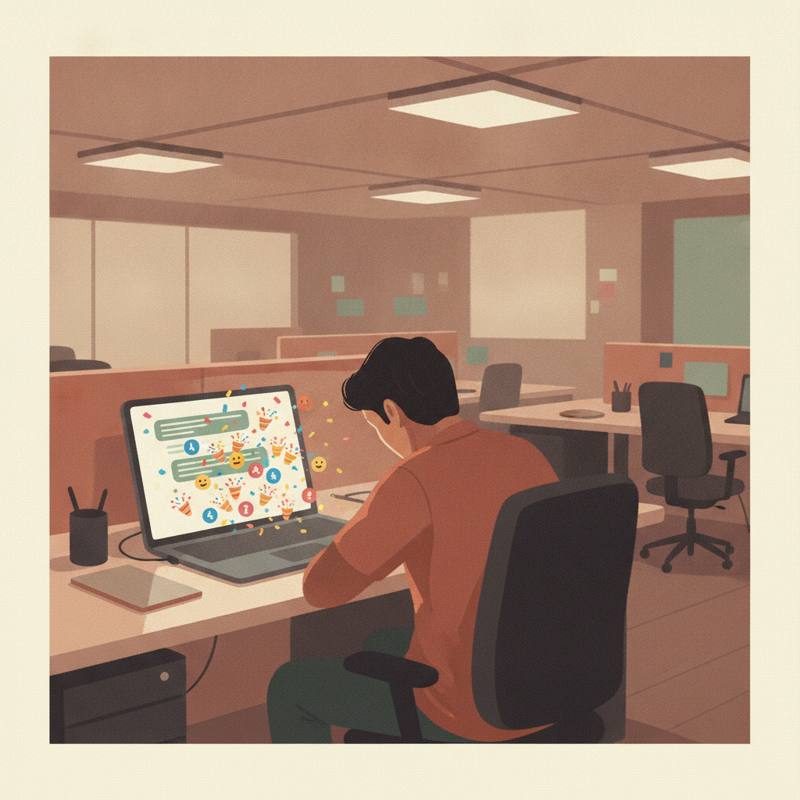
Somebody ships a feature on a Friday afternoon. Somebody else posts about it in the team channel. Within ten minutes the message wears a little crown of reactions. Party poppers. Rocket ships. A row of clapping hands. Somebody adds the confetti cannon, because of course somebody does.
And the person who did the work reads all of it on a Sunday night and feels... nothing much.
I've watched this happen. I've been the person adding the party popper. I've been the person on the receiving end, scrolling past my own little parade of icons and wondering why none of it landed.
Zach Mercurio gave me the answer when he joined Debra and me on Corey-osity Unleashed. It's eight words long, and it hasn't left my head since.
Objects don't value people
Zach researches what he calls mattering. He describes it as "the experience of feeling significant to individuals, feeling seen, heard, valued" by another person. His book on it is The Power of Mattering.
Here's what he said about the stuff companies hand out instead:
"If I symbolize your value through money or an award or through a confetti emoji or something on a platform, those are inanimate objects... Only people value people."
Only people value people.
A trophy has no opinion about you. A points balance on a kudos platform has no idea who you are. The confetti emoji doesn't know what you built, why it was hard, or what you gave up to get it done. It's a picture of a party. Nobody's at the party.
Where the moments come from
Zach didn't start out studying mattering. He started out studying meaningful work among university janitors. His team followed them for a year and a half.
The janitors didn't talk about big things. They talked about a building user who remembered their name and used it in a sentence. A supervisor who remembered a family member's birthday. Somebody who named a strength they didn't know they had.
Later his team surveyed thousands of people across 22 industries and asked when they felt they mattered most. In Zach's words, the answer kept coming back the same: "Not big actions, not perks, not programs, not awards, not money."
It came down to a supervisor remembering your name. A leader taking you aside after a meeting to point out what you did well in it. One woman told them about a boss from ten years earlier who said, "When you don't speak up, we miss out." Zach says one line kept her in her career when she was about to walk away from it.
One sentence. Ten years of fuel.
I'd love to see a kudos platform hit numbers like those.
The spending and the gap
Zach pointed to Gallup's numbers on the podcast, so I went and read them myself.
Gallup's January 2025 report found only 31% of U.S. employees engaged in 2024. Gallup calls it the lowest level in a decade. It matches 2014.
The number buried further down hurts more. Only 39% of employees strongly agree someone at work cares about them as a person. In March 2020 the figure sat at 47%.
Over those same years, as Zach pointed out, companies kept rolling out wellbeing programs, recognition programs, perks and kudos platforms. And the share of people who feel cared for at work went down by eight points.
I'm not sure about this part: Zach said over a billion dollars goes into employee engagement services. I couldn't find a source for the figure, so treat it as his estimate, not a measured number.
I'm not arguing the programs caused the drop. I'm arguing they didn't stop it. The money bought objects. The people needed other people.

Even the recognition industry agrees
Here's the part I find telling. Workhuman sells recognition software. Gallup partnered with them on recognition research. Their own write-up, There Is No One-Size-Fits-All Recognition, says a "thank you" email from the CEO and balloons around the office "aren't the kinds of recognition" which drive impact.
The same paper reports:
- Only about one-third of employees strongly agree the recognition they get is authentic.
- Only 10% strongly agree somebody at their current workplace has asked how they like to be recognized.
- 29% prefer recognition only in private. Only 7% want it only in public.
Sit with the last one. Most of the party-popper parades happen in public channels. Seven percent of people want public-only praise. Almost three in ten want none of it in public at all.
So the confetti cannon in the team channel misses most of the room before anyone even reads it.
The symbol isn't the enemy
I don't want to throw out every award and every emoji. Zach doesn't either.
He put it this way. The magic happens "when the symbols of value match up with the everyday experience of being valued."
I think of a symbol as a receipt. A receipt proves a transaction happened. If you hand somebody a receipt for something they never received, you haven't given them anything. You've handed them proof of a gap.
A party popper from a boss who talks to you every week, who knows what you're working on and what's hard about it, means something. It's shorthand. It points back to a hundred real conversations.
A party popper from a boss who hasn't asked how you're doing since your last review points back to nothing. Worse, it reminds you how little attention you're getting. The symbol becomes evidence for the prosecution.
Why we reach for the emoji
On the podcast I said something I still believe. Everybody's being asked to do more with fewer people, and AI is filling some of the gaps. People feel too busy for the small moments. And it's crazy, because those moments cost nothing.
Zach added a second reason. We've spent 25 years communicating through short digital transactions. He aimed his example at me. If I give him bad news, he sends a sad-faced emoji and a quick "sorry to hear." And each time he does it, in his words, "I don't have to sit with you."
There's the trade. The emoji lets you skip the hard bit. You get credit for responding without the cost of showing up.
And here's the uncomfortable thing for me. I like emoji. I use them all the time. They're fast. They feel friendly. Every one I send feels like a small kindness. But if I'm honest, a lot of them stand in for a conversation I didn't have time for. Or didn't make time for.
What the real thing looks like
None of this needs a budget. Here's what I'm trying, and what I'd ask you to try this week.
Follow the emoji with a sentence
React if you like. Then send one direct message to the person. Name the specific thing they did and the difference it made. "The way you handled the rollback on Thursday kept the client calm. I watched you do it and learned something." Two lines. Thirty seconds.
Ask how they want it
Remember the 10%. Ask each person on your team how they like to hear good news. Public channel? Private message? A word in the corridor? Write the answers down. Use them.
Remember one thing
Zach's janitors felt seen when somebody remembered a name or a birthday. Keep a note on each of your people. The kid starting school. The parent in hospital. The presentation they dreaded. Then ask about it next week. His own example: checking in with me about a meeting I'd felt nervous about the week before, and asking how it went.
Check the last week
Zach suggests a test worth stealing. Look back over your interactions from the last week. Count how many asked something from the person versus how many asked about the person. If the first column dwarfs the second, your symbols are writing cheques your conversations never cashed.

Where this leaves me
My research for Step It Up HR found 99.5% of people have had at least one type of bad boss. I'd bet few of those bosses thought of themselves as cold. Most of them sent the emails. Ran the awards. Clicked the confetti.
They never pulled up a chair.
So here's my question for you. Think about the last person on your team who got a wall of party poppers. When did you last sit with them, ask a real question, and listen to the whole answer?
If you don't remember, the emoji didn't do the job for you. Go do it yourself.